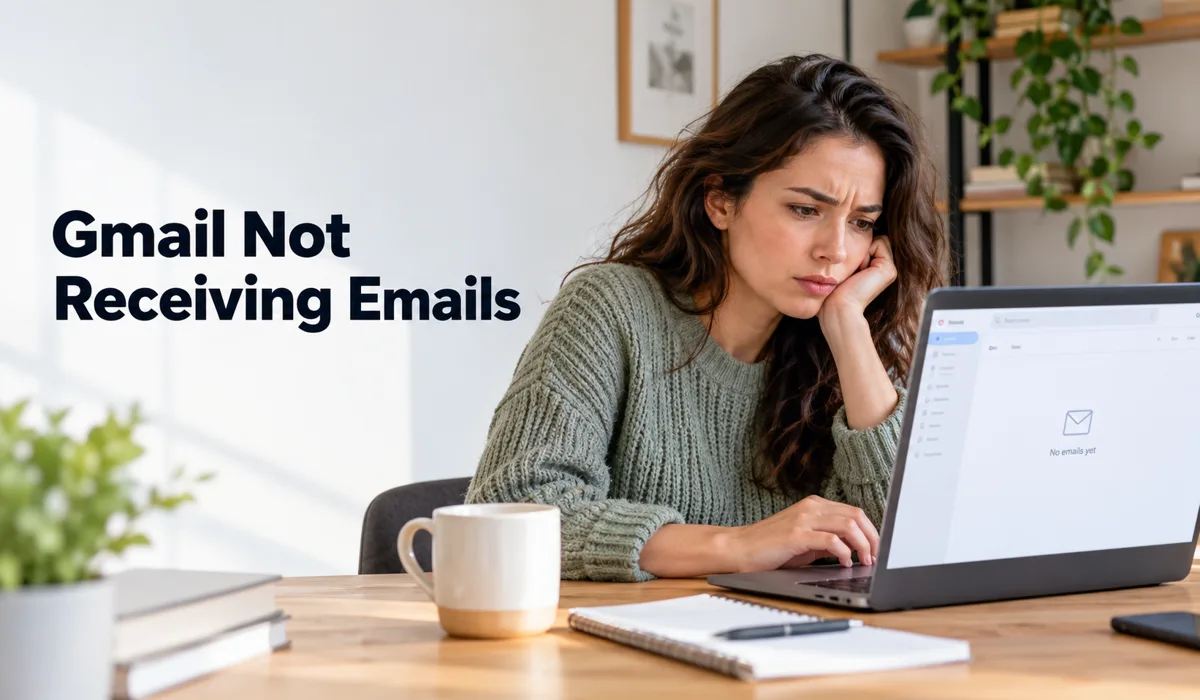
Losing an important email is a real problem, especially with no clue where it went. Gmail works fine most of the time, but there are more reasons for missing emails than most people realise. Some are tiny settings clicked by accident. Some are storage issues quietly working in the background. Some have nothing to do with you at all, just Google’s end.
Most fixes take under two minutes once you know what to look for. This guide covers the web version and the mobile app on both Android and iOS. If you know what’s wrong, jump to that section. If not, just go in order.
Quick Facts: Gmail at a Glance
Before anything else, here’s a quick reference table so you know the basics:
| Detail | Info |
|---|---|
| Service | Gmail by Google |
| Free storage | 15 GB (shared across Gmail, Drive, Photos) |
| Platforms covered | Web browser, Android app, iOS app |
| Key settings path | Settings gear – See all settings |
| Filters path | Settings – See all settings – Filters and Blocked Addresses |
| Status checker | workspace.google.com/status |
| Common symptom | Emails sent to you never arrive or go missing |
Is Google’s Storage Limit Silently Blocking Your Gmail?
People get caught out by this all the time. So here’s the thing: your Google account gives you 15 GB free. That 15 GB is split between Gmail, Google Drive, and Google Photos, which most people don’t realise. Fill it up and new emails just stop arriving. They bounce.
How a Full Google Account Stops Email Delivery
Once storage hits 100%, Gmail bounces incoming messages straight back to the sender. The sender gets an error. You get nothing. No notification. No warning anywhere in your inbox. It just looks like nobody is emailing you, which is why this is the first thing to check if the problem appeared out of nowhere.
How to Check Your Gmail Storage and Free Up Space
Here’s how to see where you stand and clear some room:
- Head to myaccount.google.com and sign in.
- Scroll to the Storage section on the home dashboard.
- You’ll see a breakdown showing Gmail, Drive, and Photos separately. Sometimes Drive is the culprit, not Gmail at all.
- Back in Gmail, try searching
has:attachment larger:10M. That pulls up the big emails hogging space. Worth a scroll through. - Delete what you don’t need, then go to Trash and click Empty Trash. Just deleting isn’t enough. The space only frees up once Trash is cleared.
- Still hitting the ceiling regularly? Google One lets you buy extra storage by the month.
Places Gmail Hides Emails Without Actually Telling You
Sometimes the email did arrive. It just landed somewhere unexpected. Gmail quietly sorts messages into places most people never open.
Your Missing Email Might Be Sitting in Spam or Trash
Gmail’s spam filter is pretty aggressive. It gets it wrong. An email from a new sender, a newsletter you signed up for, anything with certain words in the subject line, all of these can disappear into Spam without any notice. And if someone else has access to your account, something might have been deleted and be sitting in Trash. To check both:
- In Gmail, click Spam on the left sidebar. (Scroll down a bit if you can’t see it.)
- Search the sender’s name or address while you’re inside that folder.
- Found it? Open the email and hit Not Spam to push it back to your inbox.
- Go ahead and add that sender to your Contacts too. That tells Gmail to trust them going forward.
- Do the same thing in the Trash folder, just in case something got deleted accidentally.
How Inbox Category Tabs Send Emails to the Wrong Place
By default, Gmail sorts your inbox into tabs: Primary, Social, Promotions, Updates, and Forums. A receipt or a newsletter is not going to Primary automatically. So if Primary is the only tab you check, a chunk of your mail is invisible to you every single day.
- Check the tab row across the top of your Gmail inbox.
- Click through each tab. Your missing email might just be sitting in Promotions or Updates.
- Want to move an email to Primary for good? Right-click it and pick Move to tab – Primary.
- Or just turn off tabs altogether: click the Settings gear, go to See all settings – Inbox – Inbox type – Default, uncheck whatever tabs annoy you, and hit Save Changes.
Filters and Blocked Addresses Quietly Causing Problems
Filters are basically little rules that automatically sort your mail. The problem? Sometimes you create one by accident. Or you set one up ages ago and forgot about it, and now it’s auto-deleting emails from a sender you actually need. Blocked addresses do exactly what they sound like.
How to Find and Delete Filters That Are Blocking Emails
You need to get to Settings – See all settings – Filters and Blocked Addresses. That’s where everything lives. Once you’re there:
- Click the Settings gear (top right) and choose See all settings.
- Go to the Filters and Blocked Addresses tab.
- Read through each filter. Look for anything set to Delete it, Skip the Inbox, or Mark as read. Those three actions are the usual reasons emails vanish.
- Hit edit to adjust a filter, or just delete it if you don’t need it anymore.
- Ask the sender to try emailing you again and check if it lands this time.
How to Check and Unblock a Blocked Email Address
Blocked addresses are listed right on the same page. Here’s what to do:
- Still in the Filters and Blocked Addresses tab, scroll to the bottom where Blocked Addresses appears.
- Scan the list. Anyone in there you didn’t actually mean to block?
- Select the address and click Unblock.
Forwarding Settings That Redirect Your Emails Elsewhere
Forwarding is genuinely useful for managing multiple accounts. But if it was set up on a shared device, or you turned it on years ago and forgot about it, emails could be going somewhere else entirely and never appearing in your Gmail at all.
- Open Settings – See all settings – Forwarding and POP/IMAP.
- Look for whether forwarding is enabled. If it is, note the address it’s sending to.
- Don’t recognise that address? Or just don’t need forwarding anymore? Hit Disable forwarding.
- Scroll down and hit Save Changes.
- Log into that other inbox if you can and grab anything that got rerouted there.
Fixing Gmail Not Receiving Emails on the Mobile App
The Gmail app has its own set of problems that the web version doesn’t. Sync can get turned off, the app can get stale, and cached data can cause all sorts of weird behaviour.
Turn On Gmail Sync to Start Receiving Emails Again
If sync is off, the app simply stops fetching new mail. It’s one of the most common mobile-only causes.
Android:
1. Go to Settings – Accounts – Google – [your account].
2. Check that the toggle next to Gmail is switched on.
3. Hit Sync now so it pulls in mail right away.
iOS:
1. Open Settings – Mail – Accounts – Gmail.
2. Make sure Mail is toggled on.
3. Pull down to refresh inside the Gmail app itself.
Update the Gmail App and Clear Its Cache
An outdated app can cause sync failures and odd behaviour. A bloated cache can do the same thing. Here’s the fix:
- Open the App Store (iOS) or Google Play Store (Android) and search Gmail.
- If there’s an Update button, tap it.
- On Android: also go to Settings – Apps – Gmail – Storage – Clear Cache. (iOS doesn’t have this option.)
- Open Gmail again and see if new mail starts showing up.
Other Quick Fixes When Gmail Still Won’t Receive Emails
If nothing above solved it, a few more things are worth a look.
Confirm Your Internet Connection Is Stable
No connection means no new mail. Sounds basic but people skip this:
- Try loading any webpage in a browser. If it doesn’t load, that’s your problem right there.
- On Wi-Fi? Turn it off and back on. Or try mobile data instead to rule out your router.
- Reconnect and refresh Gmail.
Check Google Workspace Status for a Gmail Outage
Sometimes the problem is on Google’s side and there’s nothing wrong with your account at all. To check:
- Go to workspace.google.com/status in a browser.
- Find Gmail in the services list.
- If an outage or disruption is showing, just wait. Google’s team is already on it.
Rule Out a Sender Typo or Normal Email Delay
This one’s embarrassing but super common:
- Contact the sender another way, call or text, and ask them to read back the Gmail address they used. One wrong letter and it goes to a completely different person (or nobody).
- Have them look in their Sent folder to confirm the email actually left their side.
- For bulk sends or international emails, delays of 15-30 minutes are normal. Sometimes it just takes a bit.
Web vs. App: Where Each Gmail Problem Usually Appears
Different problems show up in different places. This table helps you skip the steps that don’t apply to your situation:
| Problem | Gmail Web | Android App | iOS App |
|---|---|---|---|
| Storage full | Yes | Yes | Yes |
| Email in Spam/Trash | Yes | Yes | Yes |
| Inbox category tab | Yes | Yes | Yes |
| Filters/blocked addresses | Yes | Settings only | Settings only |
| Forwarding misconfigured | Yes | Settings only | Settings only |
| Sync disabled | No | Yes | Yes |
| App needs update | No | Yes | Yes |
| Cache corrupted | No | Yes | No |
| Google outage | Yes | Yes | Yes |
Common Mistakes People Make When Gmail Isn’t Receiving Emails
Here are the things to watch out for as you troubleshoot. Easy mistakes to make:
- Emptying Trash before checking it – once you empty Trash, those emails are gone permanently.
- Only looking at the Primary tab – emails in Promotions or Social are still delivered, just sorted elsewhere.
- Blocking a sender instead of marking as Not Spam – that makes the original problem worse.
- Clearing app data instead of just cache on Android – clearing data logs you out and wipes local settings, which is overkill.
- Forgetting forwarding was ever set up – especially on an account you’ve had for years or shared with someone else.
- Waiting until storage is 100% full – by then, emails are already bouncing before you even notice.
Final Thoughts
Start with storage. Then Spam, Trash, and the inbox tabs. After that, filters, blocked addresses, forwarding. On mobile, check sync and update the app. Then your connection. Then the Google Workspace status page. And if all of that looks fine, the problem might just be a typo on the sender’s end.
Most cases get solved in the first three or four steps. Go through the list and you will almost certainly find what’s causing it.